
New York City Directory Collections
New York City has overlapping directory shelves rather than one continuous run. NYPL covers the Manhattan and citywide tradition, while Brooklyn has its own long sequence and reverse books. The dates matter. A person can appear in an annual volume, disappear in a publication gap, and return years later under a changed occupation or address. Record the collection as well as the year, since an entry from a Brooklyn address book answers a different question from a Manhattan name directory.
| Collection | Years | Where Held | Access |
|---|---|---|---|
| NYPL Digital Collections directories | 1786–1934 | NYPL Digital Collections; Milstein print and microfilm | Free digitized focus is 1786–1922/23; later and other volumes use the collection or onsite formats. |
| Longworth and early directories | 1796–1843, with gaps | NYPL and selected scans | Browse the surviving volume for the target year; no directory has been located for every early year. |
| Trow and later NYC series | 1852 through the 1930s, sporadic late years | NYPL Milstein and digital collection | Digital or onsite access depends on the volume. |
| Brooklyn directories | 1796–1967 | Center for Brooklyn History for 1796–1949; Central Library from 1950 on | Center for Brooklyn History research is by appointment; later material has a Book-a-Librarian route. |
| Brooklyn criss-cross directories | 1929–31, 1933–61, 1963–70, 1972–80, and 1986 | Brooklyn Public Library collections | Microfilm, bound volumes, selected digital material, and appointment access vary by run. |
Publication becomes sporadic in the 1920s and 1930s, so a missing name is not proof that a person left New York City. The last printed NYC directory identified by NYPL is a 1933/34 emergency-relief committee issue. Telephone books, newspapers, census schedules, and local collections carry the trail across those breaks.
New York City Directory Timeline
The printed sequence starts with the 1786 New-York Directory. Hodge, Allen, Campbell, and Duncan editions followed in the early years. Longworth then supplies a major early run, and Trow became the dominant nineteenth-century series. A volume's title page is evidence, not decoration: it fixes the publisher, issue year, and the spelling that should be used in a citation.
- 1786: the first known New-York Directory begins the local printed shelf.
- 1796–1843: the Longworth series produced 45 editions, with gaps in the wider early record.
- 1852 onward: John Fowler Trow began a series that ran for more than 60 years, followed by post-1915 consolidation in the Trow tradition.
- 1933/34: an emergency-relief committee issue is the last printed NYC directory identified in NYPL's history.
Use the NYPL directory-history account to select a publisher before opening scans. This avoids treating a digitized title as a complete citywide series when it may cover one borough, a social subset, a trade, or an address order.
Accessing New York City City Directories
NYPL's Milstein Division is the main Manhattan and citywide historical shelf. Its city and state directories through the 1930s are self-service in the Milstein Microform Reading Room, while older telephone-directory back files are in Microforms Room 100. The digital collection is the quickest way to identify a year, but the print or microfilm copy remains important when a scan, page, or sequence is missing.
The NYPL digitized directory collection provides the online starting point for many New York City directory years.
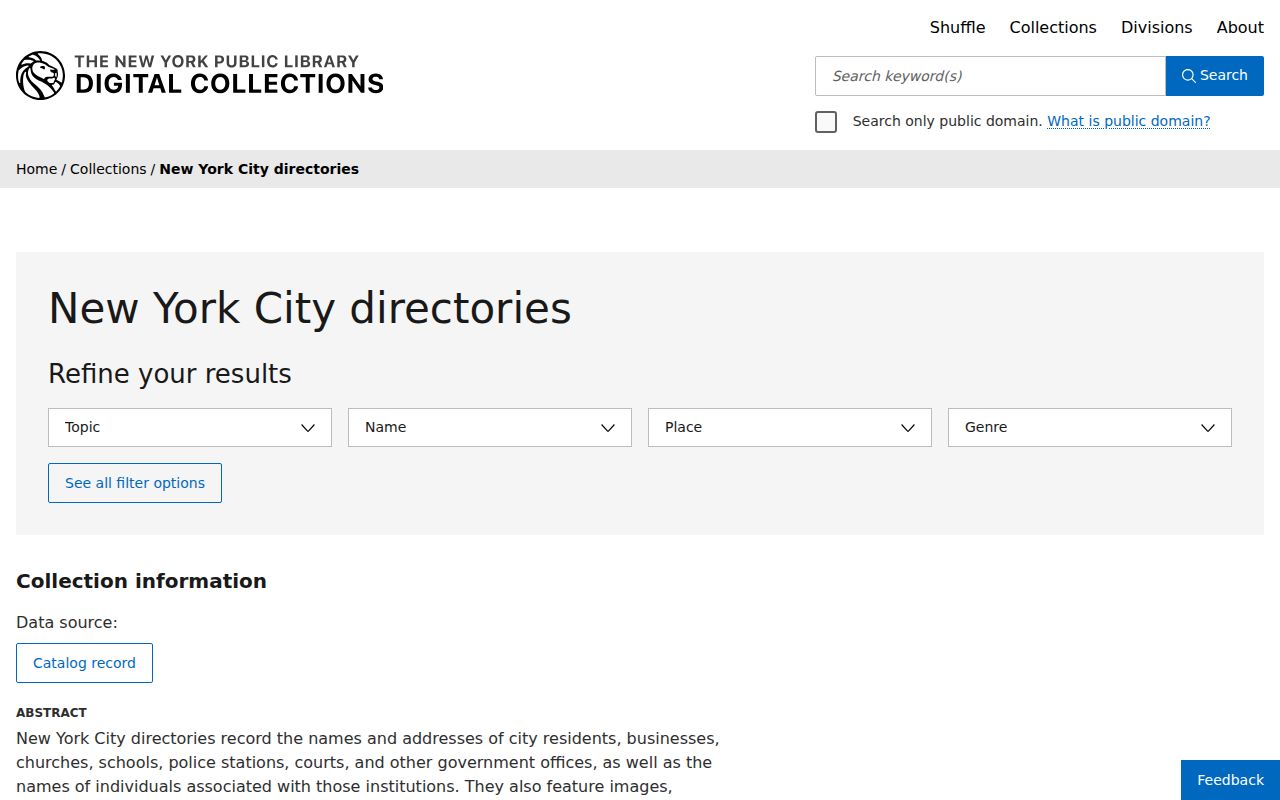
Search results and volume covers help identify a title, but a usable citation also needs the printed page, publisher, issue year, and the form of access used.
DORIS operates the Municipal Archives and Municipal Library at 31 Chambers Street, with research rooms and a collection-guide catalog for material that is not digitized. Appointments are requested at research@records.nyc.gov, or familyhistory@records.nyc.gov for family-history matters. The Industry City storage and research facility in Brooklyn is also by appointment. Ask for a finding aid and collection identifier, not a broad all-records search.
The Leonora Gidlund Reference Room and Rebecca Rankin Reading Room have public research hours from 9:00 a.m. to noon and 1:00 to 4:00 p.m. Holdings do not circulate. The Archives can supply reproductions, historic vital records, property cards, photographs, maps, blueprints, and agency records, while the Municipal Library holds government publications, manuals, City Record material, directories, and neighborhood-history sources. Current agency records stay with their creating agency, so archival research and a narrowly described FOIL request serve different needs.
Reading New York City Directory Entries
A city directory entry is compact and publisher-specific. It can connect a name with a home or business address, but it does not establish every member of a household or prove a current connection. Keep the printed punctuation and abbreviations. In New York City, an occupation or shop can appear alongside a separate home field, so those locations should never be silently merged.
| Surname and given names | The printed surname, initials, or given-name form, including variants. |
|---|---|
| Occupation | Work, employer, office, shop, or other business description where the publisher supplied one. |
| Office or shop | A work address that may differ from the residence. |
| h marker and home address | In the Brooklyn guide, h marks home; retain the street spelling and number exactly as printed. |
| Spouse or widow notation | A parenthetical spouse name or widow notation can be a family clue, not a complete household statement. |
| Page, year, publisher | The original volume evidence needed to revisit and evaluate the entry. |
- Criss-cross directory
- An address-order directory that starts with the street and house number, then names the listed occupant or business.
- Householder index
- An alphabetical name section, often centered on the person recorded at a household or address rather than every resident.
- Abbreviation key
- The publisher's explanation of its short forms, usually near the front of the volume. Photograph or transcribe it before interpreting an entry.
Brooklyn Criss-Cross Directory Years
Brooklyn's address books are the reverse side of the name index. The Center for Brooklyn History lists criss-cross runs for 1929–31, 1933–61, 1963–70, 1972–80, and 1986. It also holds Brooklyn directory, Elite, Blue Book, telephone, map, yearbook, church, and newspaper material. That local mix matters because Brooklyn's former independent-city street grids and directory traditions do not simply duplicate Manhattan's.
The Center for Brooklyn History genealogy guide explains its appointment route and the available address, directory, and microfilm formats.
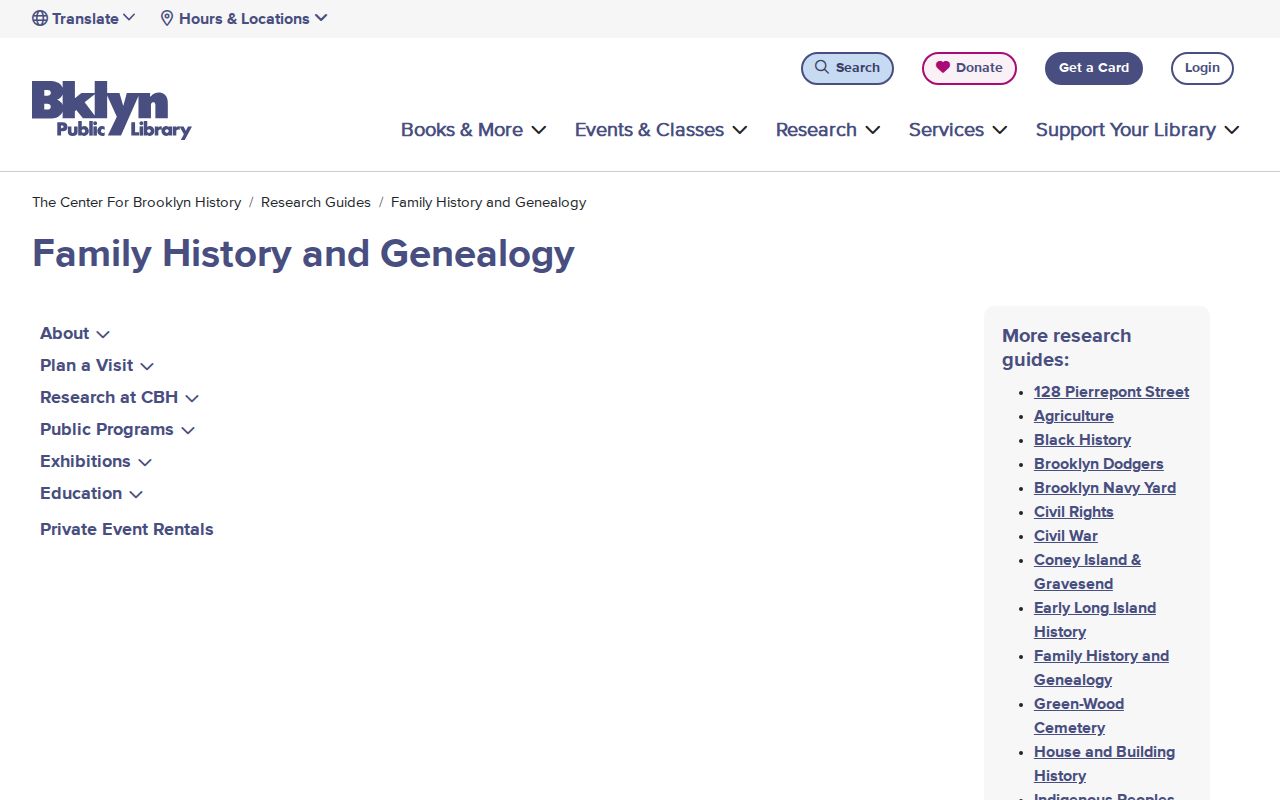
For a Brooklyn address, first identify whether the required year falls at the Center for Brooklyn History or the Central Library, then check whether a reverse volume survives for that period.
Other Brooklyn holdings fill useful gaps. Elite Publishing Company by-address books run from 1873 to 1913, and Blue Books run from 1904 to 1962 with a by-address index at the rear. The collection also lists classified telephone directories, white pages, yellow pages, and bound or microfilmed telephone books. Business headings use historic terms, so search the printed classification as well as a modern word. Each format supplies a different date and selection rule.
New York City Eardeley Family Clues
The Center for Brooklyn History's Eardeley Collection is a practical family-history companion to a New York City city directory. Its 14 microfilm reels preserve William Applebie Daniel Eardeley's genealogical notes, supported by a printed surname-to-reel index. The material connects surnames with wills, deeds, family birth and death details, spouses, children, and residences from New York's founding into the early twentieth century.
Start with the directory spelling, then use the surname index to locate the reel. A residence in the notes should be checked against the underlying will, deed, vital record, or volume page when available. The collection adds family context; it does not replace the original record.
Tracing New York City City Directories
Follow a household through available consecutive directory years, then test every change against another dated source. The newest broadly available decennial census is 1950 under the federal 72-year release rule. A directory offers a likely annual address and occupation snapshot, while the census adds enumerator-recorded household, age, and relationship context. New York City's 1890 Manhattan Police Census can add an address-based substitute where the federal 1890 schedule is unavailable.
- Normalize the borough, street, house number, unit, old street name, and any likely ward or BBL before searching.
- Find the name in a directory near the target year and record its exact spelling, initials, occupation, h marker, spouse or widow notation, publisher, page, and year.
- Check the next and previous available volumes, including a criss-cross book where one exists, for moves and other changes.
- Pair the result with the relevant census through 1950, using address or enumeration methods when a name is common.
- Close the trail with an original newspaper image, historic vital index, probate record, cemetery source, or deed record when the question calls for it.
Disappearance can mean a move, death, omission, changed name, publisher gap, or a different borough collection. Cite the original volume evidence rather than filling that gap with a present-tense assumption.
Note: A directory and census mismatch often reflects timing, a move, a renamed street, or a different person, so preserve both records.
New York City Directory Context
Five boroughs and five county identities create record geography that a single city label can hide. Brooklyn collections, Queens former-town material, Bronx annexation-era references, and Staten Island's Richmond County records can each use different locality names. Maps, tax photographs, and historical-society objects help test whether an address, building, or neighborhood label fits the directory year. They add context without converting a historical entry into a claim about who lives there now.
The New-York Historical Society eMuseum offers searchable maps, prints, photographs, ephemera, and object records that can supply that context.
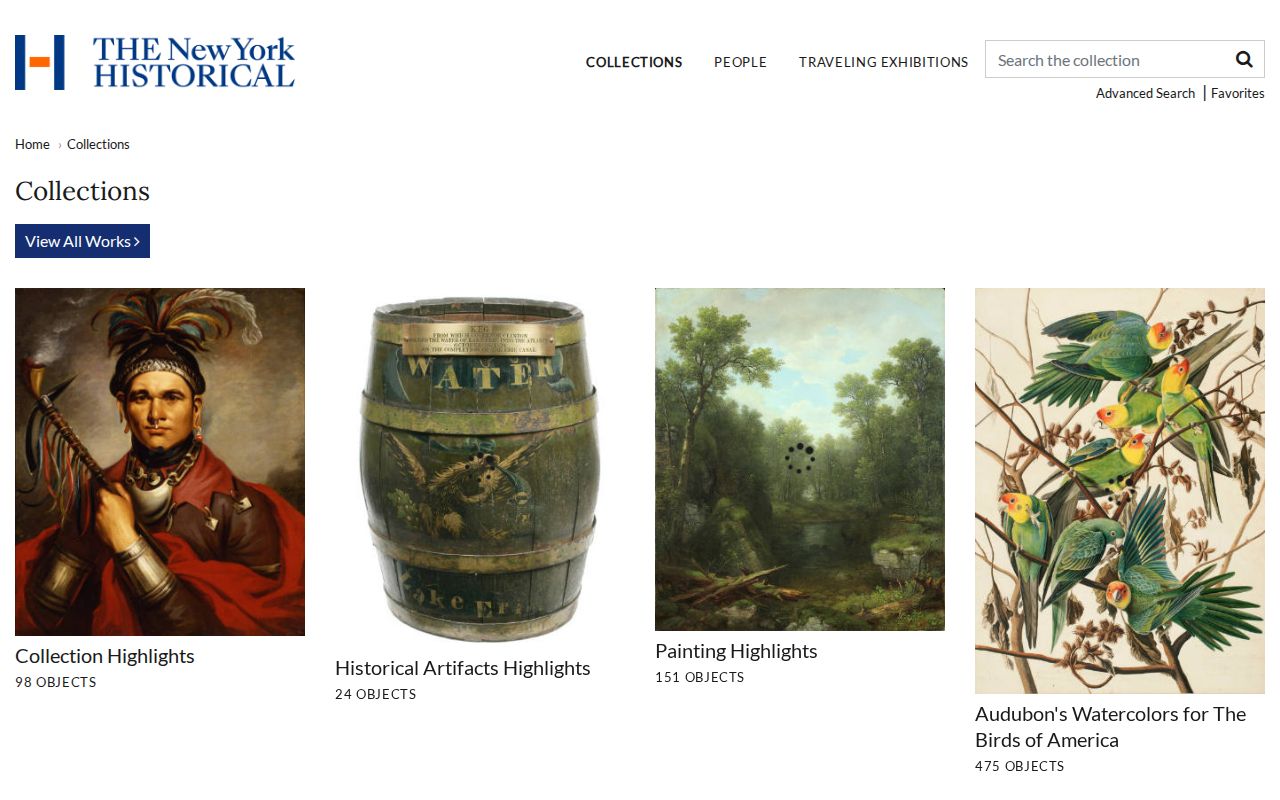
Record the object title, maker, date, collection, identifier, and image rights before relying on a historical-society item alongside a directory entry.
NYPL's map guide lists Perris, Hyde, Hopkins, Bromley, and Sanborn examples across the five boroughs. The map publisher and date can explain an unfamiliar street, ward, lot, or building label.