
New York City Resident Lookup Records
Use a resident lookup as a comparison process, not a name list. A property record may identify an owner or mailing address, a voter result may confirm an exact registration match, and a docket may show a party role. None of those answers alone establishes present residence. The most useful result ties two independent facts together, such as a dated parcel and a party role, then preserves the official source and the date searched.
| Record | What It Confirms | Where | Access |
|---|---|---|---|
| Property information | Owner or owner-of-record, property and mailing context, and BBL | NYC Property Information Portal | Public address or BBL search; the start screen is not a citywide owner-name search. |
| Recorded land instruments | Grantor, grantee, borrower, lender, or another recorded role | ACRIS for Manhattan, Brooklyn, Queens, and the Bronx; Richmond County Clerk for Staten Island | ACRIS index and images are free for 1966 to present; earlier and Staten Island research uses the custodian route. |
| Voter registration match | Whether an exact set of supplied fields matches a NYC registration | NYC Board of Elections | All five fields are required; the result is not a downloadable resident list. |
| Court or estate index | Public case, probate, or party information and a file or index number | NYS eCourts and WebSurrogate | Online coverage varies; clerks and public terminals are the file-specific fallback. |
| Historic vital record | A historical birth, death, or marriage event | NYC Historical Vital Records and Municipal Archives | Historic indexes and downloads are broad; current certificates have custodian eligibility controls. |
| Professional license | Profession, license status, original date, and public professional location | NYSED Office of the Professions | Free verification; it corroborates an affiliation, not a home address. |
Begin with the record type that matches the information already known. A street address leads to PIP and a BBL. A full name with date of birth, borough, and ZIP can support the voter confirmation route. A death date or estate question points to WebSurrogate. Where the purpose is a historical relationship, a directory, obituary image, or archive finding aid may be a better second record than a modern portal.
Checking a New York City Property Trail
For a known address, first search PIP by address or BBL and save the borough, block, lot, owner field, mailing field, tax context, and search date. A mailing address can differ from a property location, and an owner can be an entity or trust. PIP is therefore a starting point, not proof that a named person occupies the property. Do not substitute a name search for the required address or BBL starting point.
Next, carry the BBL to ACRIS. In Manhattan, Brooklyn, Queens, and the Bronx, ACRIS covers recorded real-property material from 1966 forward. Search both BBL and party name, compare the party role, and open the original instrument when it is available. Staten Island is the key New York City exception: its land records are held through the Richmond County Clerk rather than the four-borough ACRIS system.
- Enter the known property address in PIP and record the BBL, borough, owner field, and date checked.
- Use the BBL in ACRIS for the four ACRIS boroughs, or contact the Richmond County Clerk for a Staten Island land-record search.
- Compare the person’s name, role, recording date, and document number instead of treating a party name as a resident label.
- Use a second record, such as a voter match, court file, historic index, or licensed-profession result, to test the identification.
For a broad address chain rather than one named person, the New York City street directory route keeps the modern parcel, map, and building-record details in one place.
New York City Resident Lookup at eCourts
eCourts is a group of products, not a single complete case search. WebCivil Local accepts party name, index or case number, attorney, court or location, and date or calendar controls. WebCivil Supreme adds county, case type, and status filters for eligible active or disposed Supreme Court actions. WebCrims focuses on pending criminal cases and future appearances for participating courts. WebFamily is restricted, and NYSCEF Guest Search reaches eligible public e-filed cases where documents are not confidential.
The New York State eCourts gateway shows the separate court-search products and their different coverage.
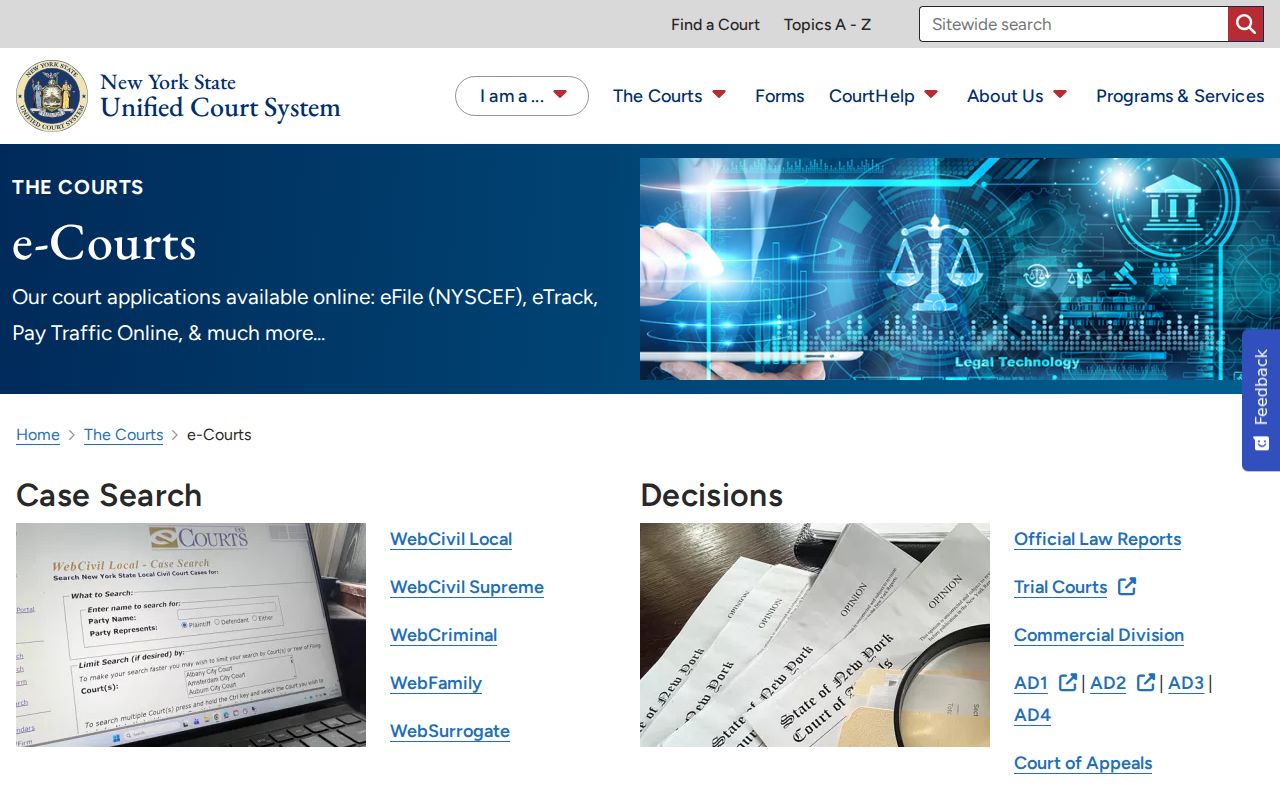
A public court hit can show a caption, party name and role, county, case or index number, court, judge, status, filing or appearance history, and links to eligible documents. It can also be absent because the matter is sealed, not yet entered, outside the product’s public display period, filed under a name variant, or held in a different county.
| Case or index number | The identifier to preserve for a clerk, court terminal, or case-specific request. |
|---|---|
| Caption and party role | The case title and the person’s role, such as party, fiduciary, plaintiff, or defendant. |
| Court and county | The tribunal and borough or county needed to locate the custodian. |
| Status and event history | Public filing, appearance, next-event, or disposition information where the product displays it. |
| Document link | A link to an eligible public e-filed document, not a guarantee that the whole file is online. |
For an older, non-e-filed, or limited web result, call the relevant borough clerk or county clerk with the exact docket or index number. Public-access terminals may show more than an online summary. A written request under Judiciary Law §255 can ask a clerk to search a specified file and provide a copy or certification; FOIL is not the route for the judicial file itself.
New York City WebSurrogate Estates
WebSurrogate is the focused New York City resident lookup route when an estate, heir, fiduciary, or will is the question. Search by party name and date of death, file number, old index name or file, index book, or will testator. Preserve the county, file number, proceeding type, date, status, and any public document description. Estate records can provide a lawful family-history lead, but a file can be absent, restricted, or unrelated to the person with the same name.
Older images are often courthouse-only, particularly pre-2014 material, and the public system has CPI restrictions. Use the Surrogate’s Court in the relevant borough as the custodian for a specific file. Pair a file history with an obituary image, historical vital index, and recorded deed only when the names, dates, and roles actually line up.
Verifying a New York City Resident
A same-name result remains unresolved until several details agree. Preserve apostrophes, spaces, diacritics, initials, suffixes, former surnames, and the exact order shown by the source. In an ACRIS party index, a name may appear in last-name, first-name, middle-initial form. A court or estate result should be compared with its date, county, role, and number rather than matched on a name alone.
- Anchor the name to a known address through PIP, save the BBL and owner or mailing context, and record the date checked.
- Search ACRIS by BBL and by party name for the four covered boroughs, or use the Richmond County Clerk path for Staten Island.
- Use the NYC voter tool only when first name, last name, birth date, borough, and ZIP are all known exactly. A match confirms registration, not a list of personal details.
- Search eCourts, NYSCEF, or WebSurrogate in the likely county, then record the docket or file number, party role, type, date, status, and document-link availability.
- Cross-check a historical vital index, obituary, directory, or professional record. If the matter requires legal proof, request a certified copy from the custodian.
- Docket
- The court’s running record of a case, showing filings, appearances, events, and status when public access permits.
- Index versus image
- An index is a searchable description or pointer. An image is the underlying scanned page or document, which may have separate access limits.
- Certified copy
- A copy issued or authenticated by the office holding the record for a use that requires official confirmation.
New York City Vital Record Checks
Historical Vital Records, or HVR, offers browse, name, and certificate search for historic New York City events. Its name search uses a required certificate type, required last name, optional first name, borough, and four-digit year. The historic split is generally births before 1910, deaths before 1951, and marriages before 1950 at the Municipal Archives. The portal supports free downloads where images are digitized, and the Archives can search or order a historic record when a scan is unavailable.
Current birth and death certificates remain with NYC DOHMH, while the City Clerk holds marriage records from 1950 forward. Those channels use identity and eligibility controls. An old index entry is not a current certificate and does not remove those rules. For Municipal Archives material, requests can proceed online, by mail, or through an appointment for in-person research; give the name, record type, borough, year or range, and certificate number if known.
NYSED in a New York City Lookup
NYSED Office of the Professions verification can corroborate a professional affiliation. Select the profession, enter at least three letters of the last name, then a space and first name. Do not use a comma. Names with punctuation may need variants, such as O Neil and ONeil. A full license-number search requires six digits, with special older formats for some registered nurses.
The NYSED verification instructions describe the profession, name, and license-number routes.
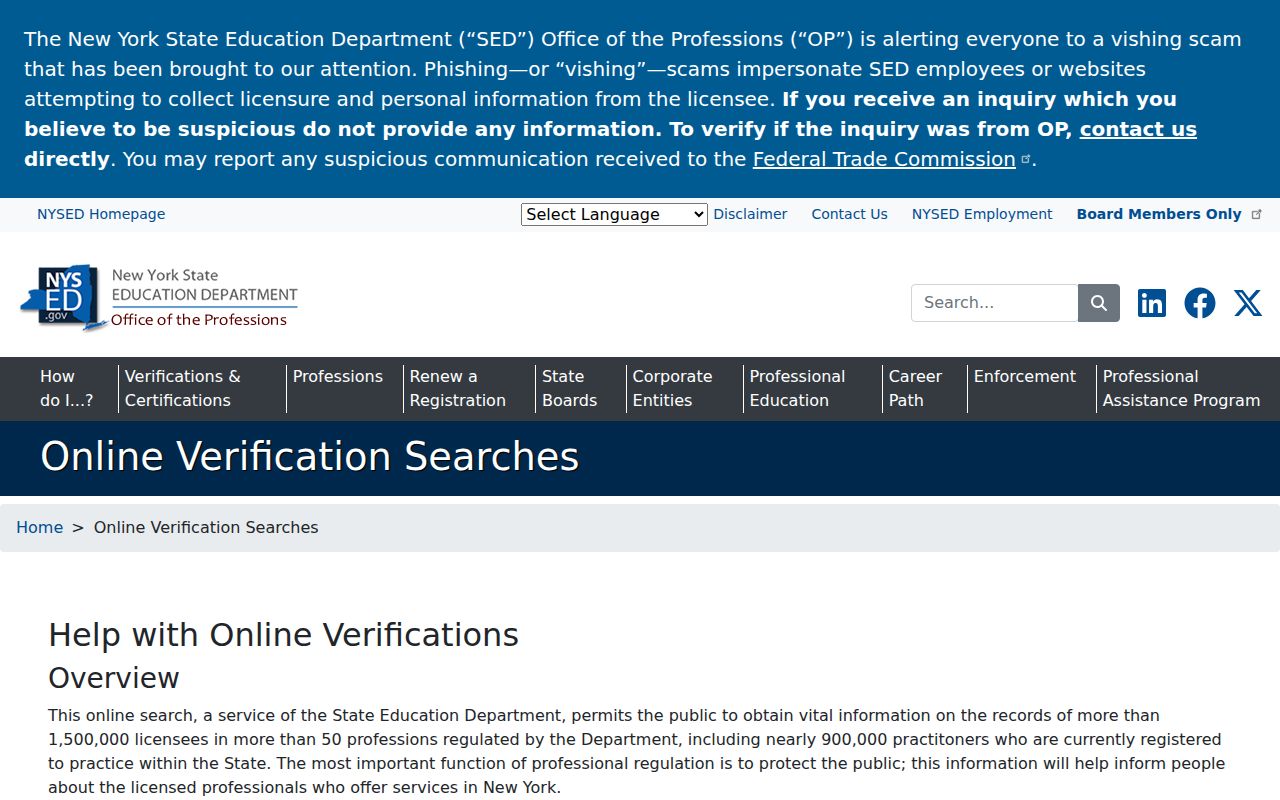
Results may show the profession, license or registration number, original license date, status, discipline information, and public professional location. That location is not a residence, and the person need not live in New York City or New York State. Older coverage can be incomplete, so use the result as one dated affiliation check.
Limits on New York City Resident Lookup
New York FOIL, Public Officers Law Article 6, opens many agency records but permits privacy redactions under §§87(2)(b) and 89(2)(b). It does not require an agency to create a new person profile, and it does not replace court access rules. A narrow FOIL request should describe an existing agency record. Courts use Judiciary Law §255 for a specific file. Voter-file requests have an Election Law §3-103(5) elections-purpose certification, so the public five-field BOE form is the appropriate confirmation channel for a known person.
Protected records and addresses remain protected. New York’s Address Confidentiality Program, Executive Law §108 and 19 NYCRR Part 134, gives eligible participants a substitute address and requires agencies to safeguard the actual location. Confidential-voter procedures are separate through the State Board of Elections. Family, adoption, juvenile, sealed, protected-person, and restricted vital matters can also be unavailable even when a name is known.
Lawful use. Use New York City records for a personal, lawful question and stop when the available evidence answers it. Do not use a resident lookup to stalk, harass, intimidate, or expose a protected person.
When an indexed name or address is wrong, ask the custodian for its correction, privacy, or redaction procedure. For a recorded instrument, contact the City Register or Richmond County Clerk. For a privacy concern in an agency record, request the office’s protected-person process or an electronic copy with exempt fields redacted.